Your Cart is Empty

Yes — but the result depends entirely on which software you use and how the conversion is performed. PNGis a raster format composed of pixels. EPS is a PostScript-based container that may contain vector data, raster data, or both.
Different applications treat this transformation very differently. Some merely wrap the raster image inside an An EPS file container, while others attempt geometric reconstruction.
Important baseline:
PNG → pixels
EPS → container, not a guarantee of vectors
Software choice determines the technical outcome

There are multiple software routes available. They vary significantly in workflow logic, control, and output quality. Below is a practical overview of the most common options.
Adobe Illustrator is designed for vector geometry and remains the most predictable environment for generating a true vector EPS.
Capabilities:
✓ Place PNG and manually reconstruct shapes
✓ Image Trace for automatic vectorization
✓ Full path and node control
✓ Production-oriented output
Typical use cases:
Logos
Print graphics
Cutting / plotting workflows
Scalable artwork
Nuance: automatic tracing often requires cleanup.
Inkscape is a technically valid alternative with similar conceptual capabilities.
Capabilities:
✓ Import PNG images
✓ Trace Bitmap (automatic vectorization)
✓ Manual path editing
✓ Export to EPS / PDF / SVG
Advantages:
✓ No licensing cost
✓ Suitable for vector reconstruction
Limitations:
✗ Different PostScript/PDF interpretations
✗ Cleanup often required after tracing
Photoshop is frequently misunderstood in EPS workflows.
Capabilities:
✓ Open PNG files
✓ Save/export to EPS
Critical limitation:
✗ No true vector reconstruction
✗ Output EPS typically contains raster data
Photoshop can generate an EPS container, but not a vector EPS derived from geometry.
CorelDRAW is widely used in signmaking and print workflows.
Capabilities:
✓ Import PNG images
✓ PowerTRACE (automatic vectorization)
✓ Manual vector editing
✓ Export to EPS
Strength:
✓ Production-focused geometry tools
Nuance: tracing artifacts remain a consideration.
Various web-based converters claim PNG → EPS functionality.
Typical behavior:
✓ Fast and accessible
✗ Limited control over geometry
✗ Often generate raster EPS or noisy vectors
Risk factors:
Excessive nodes
Poor curve logic
Unpredictable production behavior
Suitable mainly for quick previews, not critical production assets.
Dedicated vectorization utilities (desktop or web-based) focus on automated tracing.
Capabilities vary, but common traits include:
✓ Automated path generation
✗ Limited geometric refinement control
✗ Cleanup frequently necessary
Choosing software is not merely a usability decision. It directly affects:
✓ Whether vector paths are generated
✓ Node density and path stability
✓ Print and RIP behavior
✓ Cutting / plotting reliability
A valid EPS file can still contain only raster imagery.
Photoshop can create an EPS file from a PNG, but you should be clear about what you’re getting: Photoshop will produce an EPS container that typically contains raster data, not a true vector EPS made of paths and curves. Photoshop is a raster editor. It can upscale, retouch, and prepare pixel images, but it does not reconstruct vector geometry from pixels.
If your goal is scalable vector geometry (logos for print, plotting, cutting), Photoshop is the wrong tool. If your goal is a print-friendly raster EPS for a workflow that specifically requests “EPS” as a delivery container, then Photoshop can be acceptable—provided you control resolution and compression.
Before touching Photoshop, decide what the EPS is for:
If you need true vector behavior (infinite scaling, clean edges, cutting paths): you need vector reconstruction in a vector editor.
If you only need a container format that a legacy workflow accepts: a raster EPS may be sufficient.
Why: EPS is a container. “Having .eps” does not automatically mean “it’s vector.”
Open Photoshop
File → Open and select your PNG
Check color mode: Image → Mode
Typical guidance:
For most print workflows: CMYK may be required (depends on provider)
For general-purpose delivery: RGB may be acceptable
Why: you’re defining how pixel values will be interpreted downstream. Color mode mismatches are a frequent production issue.
Go to Image → Image Size…
Decide the final output size (in inches/mm/cm)
Set resolution appropriately:
Common print baseline: 300 ppi at final size (not a universal law, but a practical default)
Critical distinction:
If you change Resolution with Resample OFF, you are only changing metadata (no new pixels).
If you need more pixels, turn Resample ON and set width/height in pixels or physical dimensions.
Why: raster quality is governed by pixel count at the final printed size. DPI/PPI without enough pixels is meaningless.
Optional but often necessary:
Remove stray transparency artifacts
Ensure background behavior is intentional (transparent vs solid)
Avoid fine noise that will become visible in print
Why: EPS workflows can be sensitive to transparency handling and edge artifacts.
EPS/PostScript workflows can be problematic with complex transparency.
Practical options:
If your output must be predictable: flatten transparency (or place on a solid background)
If transparency is required: validate with the receiving workflow
Why: transparency support depends on the interpreter/RIP path. EPS is legacy; assumptions cause surprises.
File → Save As…
Choose format: Photoshop EPS
In EPS options:
Preview: any (workflow-dependent)
Encoding: Binary/ASCII (workflow-dependent; Binary often smaller)
Include vector data: typically not applicable for raster PNG-derived content
Why: you’re producing a raster EPS. Settings affect compatibility and file size, not vector geometry.
Do not trust the extension. Verify structure and behavior.
Checks:
Reopen the EPS in Photoshop: confirm it rasterizes as expected
Open in a vector viewer/editor (Illustrator/Inkscape): confirm whether it’s just an embedded image
Zoom extremely: do edges show pixel structure? (they will, if it’s raster)
Why: this prevents the classic failure: delivering “EPS” that the recipient assumed was vector.
The recipient explicitly accepts raster EPS
The output size is fixed and known
You can supply sufficient pixel resolution at final size
No cutting/plotting/vector edits are required
You need a true EPS vector file
The file will be scaled across many sizes
The workflow requires paths (logos, cutting, plotting)
You need clean, editable geometry
No true EPS vector geometry (no paths/curves generated from the PNG)
Photoshop is subscription-based (cost)
Learning curve for correct sizing/color management
Not intended for vector reconstruction or production-grade vector output
Illustrator can generate an EPS file from a PNG, but the technical outcome depends on the workflow you choose. PNG is raster data composed of pixels. EPS is a container format that can hold vector geometry or raster imagery. Illustrator is a vector-native application, which means it can reconstruct vector paths from a raster image — but this is an interpretation process, not a true conversion.
Important baseline:
Opening a PNG and saving as EPS → raster EPS (no vector advantage)
Using Image Trace → vector paths generated (quality varies)
Manual reconstruction → production-grade vector geometry
The following workflow describes the Image Trace method, which is widely used as a starting point.
Open Illustrator
File → Place → select your PNG
Avoid copy-paste placement
Why: placed images retain predictable scaling and interpretation behavior.
Select the image
Go to Window → Image Trace
Illustrator initially shows a preview-based interpretation.

Critical nuance: preview output is not yet vector geometry. Paths are created only after expansion.
Common presets include:
Black & White Logo
3 Colors / 6 Colors
High Fidelity Photo
Low Fidelity Photo
Presets influence how pixel transitions are interpreted.
Why: presets optimize appearance, not geometric efficiency. Treat them as temporary.
Key parameters:
Mode
→ Controls color interpretation (Black & White / Grayscale / Color)
Threshold (for B/W workflows)
→ Determines what becomes shape vs background
Paths
→ Higher values increase accuracy but inflate node count
Corners
→ Affects corner detection behavior
Noise
→ Filters small pixel variations
Why: tracing quality is governed by geometry, not visual similarity. Excessive accuracy often produces unstable vector structure.
Object → Image Trace → Expand
What changes technically:
✓ Raster preview becomes vector paths
✓ Nodes and curves are generated
✓ Structural complexity becomes visible
Without Expand, no true vector exists.
After expansion, inspect and correct:
Excessive nodes (node inflation)
Irregular curves
Micro-artifacts
Fragmented shapes
Open paths (when shapes are required)
Why: automated tracing rarely produces production-stable geometry.
Potential downstream issues if skipped:
RIP/render anomalies
Cutting/plotting instability
Large file sizes
Scaling artifacts
Switch to Outline View.
Check for:
✓ Logical path structures
✓ Minimal unnecessary segmentation
✓ Stable curves
✓ Absence of hidden raster remnants
Why: screen preview can hide structural defects.
File → Save As…
Choose Illustrator EPS
Remember:
EPS extension does not validate vector quality
File content determines production behavior
Image Trace is an algorithmic interpretation engine. It does not understand design intent. Typical artifacts include:
✗ Excessive anchor points
✗ Wobbly curves
✗ Shape fragmentation
✗ Inconsistent edges
For logos, brand marks, and precision-critical graphics, tracing often requires correction or full reconstruction.
Manual tracing produces:
✓ Clean curves
✓ Minimal node count
✓ Predictable scaling
✓ Production-stable geometry
Why this matters:
Vector quality is defined by geometric logic, not visual resemblance alone.
✓ Rapid generation of vector paths
✓ Full control over resulting geometry
✓ Flexible export formats (EPS / AI / PDF / SVG)
✓ Suitable for simple graphics and icons
✗ Subscription-based software
✗ Learning curve for path control and QC
✗ Automated tracing frequently needs cleanup
✗ High-quality reconstruction may be time-intensive
Illustrator can produce a true vector EPS from a PNG, but only through vector reconstruction, either automated (Image Trace) or manual (Pen Tool). The EPS format itself does not determine quality — the underlying geometry does.
Converting a PNG to EPS without paid software is entirely possible, but the technical implications remain the same. PNG is raster data composed of pixels. EPS is a container format capable of storing either raster imagery or vector geometry.
A free workflow does not change the core reality: true vector EPS output requires geometric reconstruction, not simple format conversion.
Critical baseline:
Exporting PNG → EPS directly → raster EPS
Vector EPS → requires path generation
File extension alone is meaningless
The objective is therefore not “free conversion”, but free vector reconstruction.
Inkscape is the most practical free solution for generating an EPS file from a PNG.
Capabilities:
✓ Import PNG files
✓ Trace Bitmap (automatic vectorization)
✓ Full node and path editing
✓ Export to EPS / PDF / SVG
Important nuance:
Tracing generates new geometry based on pixel transitions. Output quality depends heavily on image structure and parameter control.
GIMP is sometimes mistaken for a vectorization tool.
What it can do:
✓ Prepare raster images
✓ Improve contrast / reduce noise
✓ Remove backgrounds
What it cannot do:
✗ Generate vector paths from pixels
✗ Produce true vector EPS geometry
Saving to EPS from GIMP typically produces raster content inside an EPS container.
Various web tools advertise PNG → EPS conversion.
Typical characteristics:
✓ Immediate accessibility
✗ Limited geometric control
✗ Often generate raster EPS
✗ Vector output frequently contains excessive nodes
Automated online conversion prioritizes convenience over geometric stability.
Open Inkscape
File → Import → select PNG
Choose Embed
Why: ensures the image becomes a stable reference object.
Select the image
Path → Trace Bitmap
Choose method based on image type:
Single Scan → Brightness Cutoff → simple logos / high contrast
Multiple Scans → Colors → limited color graphics
Why: tracing strategy directly determines path complexity.
Key considerations:
Threshold → controls shape detection
Scans → more detail vs more nodes
Smooth → curve simplification vs distortion
Noise filtering → suppress micro-artifacts
Overly aggressive settings commonly produce unstable geometry.
Click OK.
Result:
✓ Vector geometry created
✓ Vector object placed above raster
Immediately verify by moving the top object.
Remove or hide the raster.
Check via node tool:
✓ Nodes visible → vector confirmed
✗ Image object only → raster still present
Inspect for:
Node inflation
Fragmented shapes
Irregular curves
Typical corrections:
✓ Delete micro-artifacts
✓ Simplify paths cautiously
✓ Correct curve irregularities
✓ Ensure closed paths when needed
Why: automated tracing rarely produces production-ready geometry.
File → Save As
Choose EPS
Important:
EPS validity does not equal vector quality. Always verify output behavior.
Free tools can generate technically valid EPS files, but limitations include:
✗ Increased cleanup effort
✗ Interpretation differences across viewers/RIPs
✗ Node-heavy geometry from tracing
✗ Reduced automation compared to commercial tools
The constraints are geometric, not financial.
PNG → EPS Free is trivial at the container level, but meaningful vector EPS output still requires:
✓ Path reconstruction
✓ Node control
✓ Curve refinement
✓ Quality verification
Software cost does not eliminate vectorization discipline.
If you lack knowledge of Adobe Illustrator or Inkscape and do you not want to purchase a monthly subscription? Then you can use our vector service. You pay once and receive your vector files within 10 hours.
Watch the video below to learn how the vector service works.
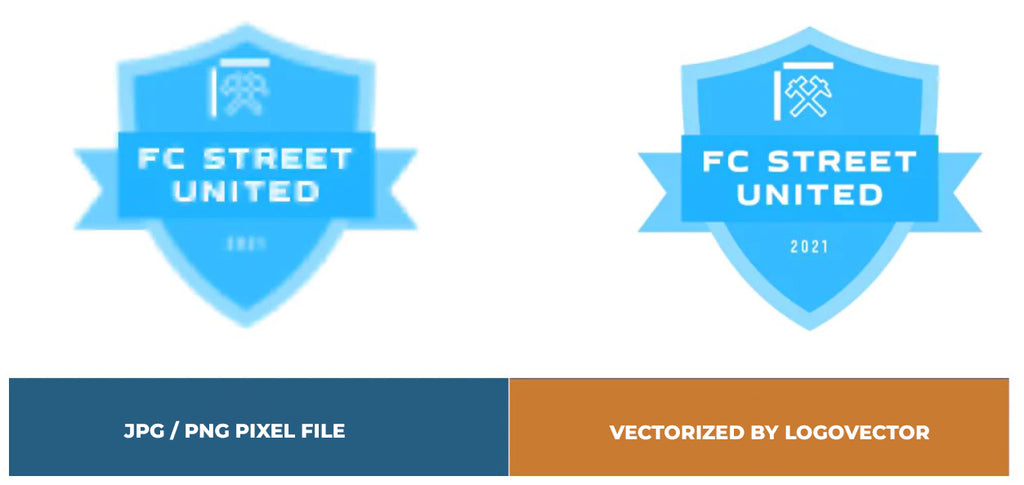
We are happy to help you on your way with vectorizing your logo or image. You send us the logo in JPG, PNG or PDF and we convert the logo into an EPS vector file using Adobe Illustrator. We use the pen tool and recreate the logo manually with the correct fonts. Then we export the new vector logo in an EPS file so you can get started!
Advantages of vector file creation by Logovector: