Your Cart is Empty

EPS file (Encapsulated PostScript) is a PostScript-based graphics container designed for device-independent graphic exchange. It is widely used in print and production workflows because PostScript interpreters and RIP engines natively understand its structure.

Critical technical nuance:
EPS is a container format, not a guarantee of vectors
An EPS file may contain vector filedata, raster data, or both
The .eps extension alone does not define scalability or quality
An EPS file behaves as a true vector file only when it contains geometric path data.
EPS is commonly used in workflows where predictable rendering and device independence are important. The format remains prevalent in printing, signmaking, and legacy production systems due to its PostScript foundation.
Typical use cases include:
✓ Logo and brand asset exchange
✓ Professional printing workflows
✓ Plotting / cutting applications
✓ Cross-application compatibility
However, the usefulness of an EPS depends entirely on its internal structure. An EPS containing only raster data behaves like a normal image when scaled.
Vector graphics are defined mathematically using paths, curves, and nodes. These geometric definitions allow artwork to scale without interpolation artifacts.
Vector characteristics:
✓ Resolution-independent scaling
✓ Stable edge reproduction
✓ Geometric editability
✓ Production suitability
Raster graphics (JPG / PNG) differ fundamentally.
Raster characteristics:
✓ Pixel-based structure
✓ Resolution-bound detail
✓ Scaling via interpolation
✓ Edge degradation when enlarged
The structural model — not the file extension — determines behavior.
Raster images can be enlarged technically, but no new detail information is created. Instead, pixels are interpolated, which often introduces softness or visible artifacts.
Consequences of raster scaling:
✗ No geometric reconstruction
✗ Edge clarity degradation
✗ Visible interpolation effects
Vector graphics avoid this limitation because shapes are recalculated rather than resampled.
Multiple applications can generate EPS files, but their outputs differ depending on whether the software is vector-native or raster-native.
Common vector-native applications:
✓ Adobe Illustrator
✓ Inkscape
✓ CorelDRAW
Raster-native applications (such as Photoshop) can also save EPS files, but typically embed raster imagery rather than vector paths.
Critical nuance:
Creating an EPS file does not automatically produce vector geometry.
EPS files can be opened by several programs. The experience and editability depend on the application and the internal content of the file.
Most widely used professional environment.
✓ Full vector interpretation
✓ Editable paths (when vector data exists)
✓ Reliable production previews
Requires subscription licensing.
Free vector-native alternative.
✓ Opens many EPS files
✓ Allows vector inspection and editing
✗ Interpretation differences may occur
Some applications display EPS content by rasterizing internally.
✓ Suitable for viewing
✗ Not suitable for vector validation or editing
What is an EPS file and what is an EPS file used for? EPS is a vector file format often required for professional and high-quality image printing.
Creating an EPS file from a PNG is technically simple, but the meaningful result depends on what kind of EPS you produce. A PNG is raster data composed of pixels. EPS is a container format capable of storing either raster imagery or vector geometry. Merely exporting PNG → EPS does not generate vectors.
Critical baseline:
PNG → pixels
EPS → container (vector not guaranteed)
Exporting format ≠ reconstructing geometry
If your goal is a true EPS vector file, vector reconstruction is required. Illustrator is commonly used because it is vector-native and provides tracing and path tools.
Open Illustrator
File → Place → select PNG
Avoid copy-paste workflows
Why: placed images retain predictable scaling behavior and avoid hidden resolution inconsistencies.
Before tracing, evaluate the image:
✓ Logo / icon / flat graphics → good candidates
✗ Complex photos / textures → often inefficient
Why: vectorization reconstructs geometry from contrast. Photographic detail produces excessive path complexity.
Select the image
Window → Image Trace
Illustrator initially displays a preview interpretation.
Critical nuance: preview output is not yet vector geometry.
Select mode based on image structure:
Black & White → line art / simple logos
Color → limited color graphics
Grayscale → tonal artwork
Presets are starting points only.
Important controls:
Threshold / Colors → shape detection logic
Paths → accuracy vs node count
Corners → corner behavior
Noise → artifact suppression
Excessively high accuracy typically creates unstable geometry.
Object → Image Trace → Expand
Now Illustrator generates editable vector paths.
Without Expand, no true vector structure exists.
Inspect for:
✓ Node inflation
✓ Fragmented shapes
✓ Irregular curves
✓ Micro-artifacts
Refine paths before export.
Why: automated tracing rarely produces production-stable geometry.
File → Save As
Choose Illustrator EPS
Remember:
EPS validity does not guarantee vector quality. Geometry determines behavior.
If you skip Image Trace and directly save:
EPS contains raster imagery
Scaling remains resolution-bound
No vector advantages obtained
A JPG is also raster data. The same structural logic applies: exporting JPG → EPS without vector reconstruction produces a raster EPS. Vector behavior requires path generation.
Many online converters advertise JPG/PNG → EPS functionality. Their outputs vary:
✓ Convenient access
✗ Vector data not guaranteed
✗ Often raster EPS or noisy geometry
Common misunderstanding:
Changing the file extension or container does not convert pixels into vector paths.
Production workflows frequently require:
✓ Clean vector geometry
✓ Stable curves and nodes
✓ Predictable scaling
Raster EPS files remain resolution-dependent and may produce soft or pixelated edges when resized.
A vector EPS is only “vector” if the file actually contains paths and curves, not an embedded image. Illustrator can create vector geometry from a JPG/PNG in two fundamentally different ways:
Image Trace (automated reconstruction)
Pen Tool (manual reconstruction, production-grade)
Image Trace can be fast, but it often produces unstable geometry (excessive anchor points, wobbly curves, fragmented shapes). For logos and print-critical artwork, the quality is determined by path structure and cleanup, not by the EPS extension.
Below is a complete production-oriented workflow.
Good candidates:
Logos, icons, flat graphics
Line art with clear edges
Limited-color artwork
Poor candidates:
Photos with texture, hair, gradients
Low-resolution JPGs with compression artifacts
Noisy screenshots
Why: tracing converts pixel transitions into geometry. Noise becomes anchor points and micro-shapes.
Open Illustrator
File → Place…
Select your JPG/PNG and place it on the artboard
Why: placed images keep predictable scale and avoid hidden transformations that affect tracing.
Zoom to 200–400% and inspect:
blockiness / “mosquito noise” around edges (common in JPG)
soft edges and halos
tiny details that won’t survive print/cutting
Why: if edges are already compromised, tracing will bake that into geometry.
Select the placed image
Window → Image Trace
Choose a mode aligned with the artwork:
Black & White → logos, line art, 1-color graphics
Color → flat multi-color artwork
Grayscale → tonal illustrations (use sparingly for production)
Why: the mode defines how Illustrator segments pixels into shapes. Wrong mode = wrong structure.
Presets like High Fidelity Photo or Low Fidelity Photo are not inherently “better”—they simply push the algorithm toward more or less detail.
Practical guidance:
For logos: start with Black and White Logo or limited-color presets
Avoid “High Fidelity Photo” for production vectors (it tends to generate massive geometry)
Why: more detail usually equals more anchor points, not better production behavior.
Key controls (names may vary slightly by version):
Threshold (B/W)
Higher threshold captures more pixels as “shape”
Too high = noise and fill creep
Paths
Higher = closer outline but more anchors (node inflation)
Corners
Higher = more corner retention (can create jagged geometry)
Noise
Higher noise filtering removes small artifacts (often beneficial)
Why: you’re balancing shape fidelity against geometric stability. Production vectors prefer clean curves over pixel-perfect wobble.
When satisfied with the trace preview, click Expand
(or Object → Image Trace → Expand)
Why: until you expand, you do not have editable paths—only a tracing effect.
After Expand, do not jump straight to export. Inspect and correct:
Fragmented shapes (multiple pieces that should be one)
Excess anchor points along smooth curves
Micro-objects caused by noise
Unnecessary overlaps between filled shapes
Typical actions:
Delete micro-artifacts
Merge shapes where appropriate (Pathfinder)
Simplify carefully (small increments)
Replace wobbly curves with cleaner Bezier segments manually where needed
Why: auto-trace generates geometry optimized for visual matching, not for stable print, RIP, or cutting behavior.
Switch to View → Outline
Inspect:
✓ clean, continuous contours
✓ minimal anchor points for smooth curves
✓ no unexpected tiny segments
✓ closed shapes where fills are required
Why: screen rendering can hide structural problems. Outline view shows the truth.
Open the Links panel and check whether the placed image is still present.
If you intended a fully vector EPS, remove the raster after expansion
Confirm that selecting artwork targets paths/shapes, not an image object
Why: many “EPS files” fail downstream because the raster is still embedded.
File → Save As…
Choose Illustrator EPS
Also save an AI master for future edits
Why: EPS is often a delivery format. AI preserves editability and structure.
If you need a brand-accurate logo, stable curves, and predictable production output, manual reconstruction is often the correct method:
fewer anchors
cleaner Bezier curves
controlled geometry
consistent stroke/shape logic
Why: “perfectly identical” in production is about geometric intent, not pixel-edge imitation.
Using High Fidelity Photo for logos
Skipping cleanup and exporting immediately
Trusting visual preview instead of outline inspection
Leaving the raster embedded in the EPS
Accepting node inflation as “detail”
Illustrator can create a vector EPS, but only if you:
generate real paths (Expand)
clean the geometry
verify structure in Outline View
export EPS from vector content—not from an embedded image
Photoshop can generate an EPS file, but the technical outcome must be framed correctly. Photoshop is a raster-based editor designed for pixel manipulation. Saving an image as EPS from Photoshop produces a raster EPS container, not a vector EPS built from paths and curves.

Critical baseline:
Photoshop → pixel editor
EPS → container format (vector not guaranteed)
Saving as EPS ≠ vector reconstruction
If your workflow requires true vector behavior (infinite scaling, clean geometric edges, cutting paths), Photoshop is not the correct tool. If an EPS container is requested for compatibility reasons and raster output is acceptable, Photoshop can be used with proper resolution control.
Before exporting anything, determine:
✓ Do you need vector geometry?
✓ Or is EPS only required as a delivery format?
If vectors are required, Photoshop cannot generate them from a raster image.
Why: EPS extension alone does not define scalability or editability.
Launch Photoshop
File → Open → select JPG / PNG / PSD
Zoom in significantly (200–400%) and check for:
Compression artifacts (common in JPG)
Soft edges or halos
Insufficient pixel dimensions
Why: raster defects remain embedded inside the EPS.
Go to Image → Image Size…
Define final output dimensions
For print-bound raster workflows:
Set target physical size
Use a practical baseline resolution (commonly ~300 ppi at final size)
Important distinction:
Resample OFF → metadata-only change
Resample ON → interpolation (new pixels generated)
Why: DPI/PPI without sufficient pixels does not improve quality.
If pixel dimensions are insufficient:
✓ Enable Resample
✓ Increase dimensions conservatively
Excessive scaling introduces visible interpolation artifacts.
Why: Photoshop cannot create new detail information.
EPS/PostScript workflows may be sensitive to transparency.
Practical options:
✓ Flatten image for predictable output
✓ Or ensure transparency is intentional and validated
Why: unexpected transparency behavior is a common production failure.
File → Save As…
Choose Photoshop EPS
Technical expectation:
✓ EPS container created
✗ File remains raster-based
✗ No vector paths generated
EPS here is simply a packaging mechanism.
Never trust the extension.
Verification methods:
✓ Reopen EPS → confirm rasterization behavior
✓ Open in vector software → typically appears as embedded image
✓ Zoom heavily → pixel structure visible
Why: prevents delivering EPS files assumed to be vectors.
EPS required purely for compatibility
Output size fixed and known
Raster quality sufficient at final size
No vector editing or cutting required
True EPS vector file required
Artwork must scale across many sizes
Workflow involves plotting / cutting
Clean geometric edges required
✓ Rapid creation of EPS container
✓ Useful for raster-based workflows
Important limitation:
✗ No vector geometry produced
✗ Not a vector file (raster EPS with pixels)
✗ Resolution-dependent output
✗ Interpolation artifacts when scaled
✗ Subscription licensing cost
✗ Unsuitable for vector reconstruction
Photoshop can create an EPS file, but it remains a pixel-based EPS. Vector advantages exist only when geometry is explicitly constructed in vector-native software. The EPS format itself does not define vector quality.
Do you have no knowledge of Adobe Illustrator or do you not want to purchase a monthly subscription for a vector file? Then you can use our one-time vector service. Watch the video below to learn how our service works.
We are happy to help you on your way with vectorizing your logo or image.You send us the logo in JPG, PNG or PDF and we convert the logo into an EPS vector file using Adobe Illustrator. We use the pen tool and recreate the logo manually with the correct fonts. Then we export the new vector logo in an EPS file so you can get started!
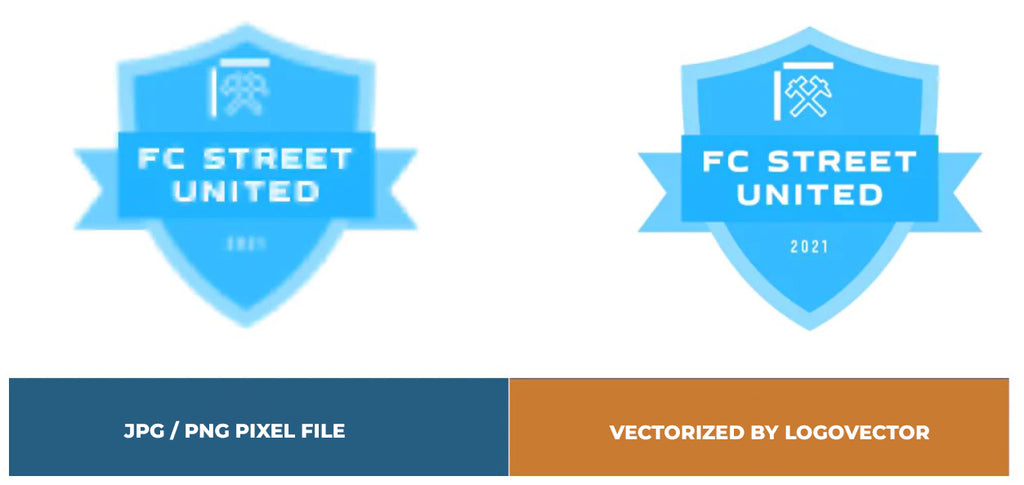
Advantages of vector file creation by Logovector: