Your Cart is Empty

PDFs are versatile file formats that can contain both raster and vector graphics. Vectorizing a PDF refers to converting any raster images within the document into vector format, which offers numerous benefits such as scalability and crisp visuals. In this blog post, we'll explore whether PDF is a vector format, how to determine if your PDF is vector, the meaning of vectorizing a PDF, and how to convert a PDF to a vector file for free.

A PDF (Portable Document Format) can contain a mix of raster and vector elements. While raster images consist of pixels and are resolution-dependent, vector graphics are made up of mathematical equations that allow for infinite scalability without loss of quality. This means that a PDF can contain both raster and vector elements, making it a versatile and widely used file format.
To determine if a PDF contains vector elements, follow these steps:
If the lines, shapes, and text remain crisp and sharp even at high magnification, it's likely that the PDF contains vector elements. If these elements appear pixelated, they are likely raster images.
Vectorizing a PDF means converting any raster elements within the document into vector format. This process involves tracing the pixels of a raster image and creating corresponding mathematical equations to represent the image as a vector graphic. Vectorizing a PDF can improve the scalability, print quality, and overall appearance of the document.
Yes, you can vectorize a PDF by converting its raster elements into vector graphics. There are several tools available for vectorizing PDFs, such as Adobe Illustrator, Inkscape, and online conversion services. Keep in mind that the quality of the vectorization may vary depending on the complexity of the raster images and the capabilities of the tool you use.
The premise of “converting a PDF to a vector file” is frequently misleading. PDF is a container format, not a guarantee of vector geometry. A PDF may contain:
True vector paths
Embedded raster images
Hybrid constructs (vector + raster)
Transparency and effects that flatten variably
Opening a PDF in a vector editor does not inherently “vectorise” anything. The decisive factor is the content structure inside the PDF, not the extension.
Using Inkscape (a vector-native SVG editor) is a valid inspection and reconstruction workflow, but the process must be understood correctly.
Why: Importing a PDF only exposes its internal objects. No automatic conversion occurs.
File → Open → select PDF
Choose import options carefully (text handling, clipping, etc.)
Critical reality: If the PDF already contains vector paths, they will appear as editable objects. If it contains raster images, they remain raster.
QC check: Switch to Outline / Wireframe view immediately. This reveals whether the artwork consists of paths or image rectangles.
Why: Many PDFs are already fully vector-based. Tracing such files introduces degradation.
Indicators of real vectors:
Objects selectable as paths
Node editing available
Clean contours in outline view
Indicators of raster content:
Single image bounding boxes
No nodes present
Pixel-dependent edges
Failure mode to avoid: Tracing vectors that are already vectors → results in node inflation and geometry corruption.
Why: PDFs commonly mix raster and vector content.
Select suspected raster objects
Confirm via node tool (no nodes = raster)
Only raster elements are candidates for vector reconstruction. Vector elements should be preserved as-is.
Why: Trace Bitmap is an interpretative edge-detection algorithm, not a conversion engine.
Workflow logic:
Path → Trace Bitmap
Select mode based on structure (threshold vs multi-scan vs edge emphasis)
Parameter impact:
Higher sensitivity → more nodes, more noise
Lower sensitivity → smoother but less detailed paths
Expected artefacts:
Node inflation
Micro-segments
Curve jitter
Fragmented shapes
These are inherent to raster interpretation.
Why: Tracing generates new vector paths placed above the bitmap.
Move traced result aside
Compare against raster reference
Delete raster only after verification
Important: Deleting the raster does not improve vector quality. It only removes visual reference.
Why: Raw trace output is rarely production-stable.
Corrective actions:
Simplify paths (reduce redundant nodes)
Rebuild critical curves manually where needed
Remove specks and isolated fragments
Ensure closed paths where fills are required
QC check: Evaluate in outline view. Clean vectors show stable curvature and coherent topology.
Why: Visual similarity is unreliable.
Minimum validation:
Node density inspection
Curve continuity checks
Object selectability confirmation
Detection of remaining raster residue
For cutting/plotting workflows, also confirm:
No duplicate paths
No open endpoints
No unintended overlaps
Why: SVG, EPS, AI, and PDF are containers that preserve existing structures.
File → Save As → choose required format
Critical clarification: Exporting to SVG/EPS/AI does not vectorise raster content. Only existing paths are stored as vectors.
PDFs Often Require No Conversion
If geometry already exists, the correct workflow is extraction/editing — not tracing.
Tracing Is Reconstruction, Not Restoration
Raster PDFs cannot be deterministically converted into original vector artwork. Tracing always introduces approximation.
Containers Do Not Enforce Content Type
A “vector file format” can still contain raster data. Always verify structure.
Converting a PDF to a vector file using free tools is technically feasible only when vector geometry is present or intentionally reconstructed.
Vector validity depends on:
Path topology
Node economy
Curve stability
Absence of raster dependencies
File extensions alone never guarantee vector integrity. In production workflows, geometry is the only authoritative truth.
We are happy to help you on your way with the vectorization of your logo or image. You send us the logo in JPG, PNG or PDF and we convert the logo into an EPS vector file using Adobe Illustrator. We use the pen tool and recreate the logo manually with the correct fonts. Then we export the new vector logo in an EPS file so you can get started!
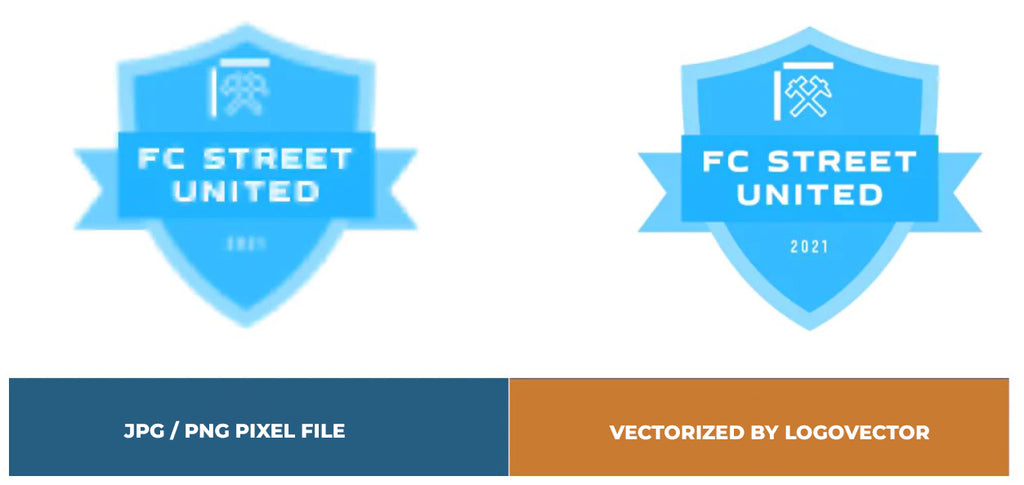
Advantages of vector file creation by Logovector: